The Carter Blog
Carter ARTicles
Working head-to-head: Mary Cassatt and Edgar Degas in Paris
Nov 25, 2026
She prepares to sit down, a colorful fan grasped in her right hand, her long green skirt gathered in her left, her gaze seeming to target the chair behind her. It’s difficult to change position with your hands thus occupied, just as it was difficult for Mary Cassatt (1844–1926) to paint her subject with distemper, a fussy glue-based paint.
I have often watched this woman with her fan, gazing backward. As an educator at the Carter, I Iike to walk the galleries as a break from lesson planning and preparation for visits to community centers and schools. However, at first I did not recognize Cassatt as the artist of Woman Standing, Holding a Fan; I tended to connect her to mother-child subjects, as many others do.


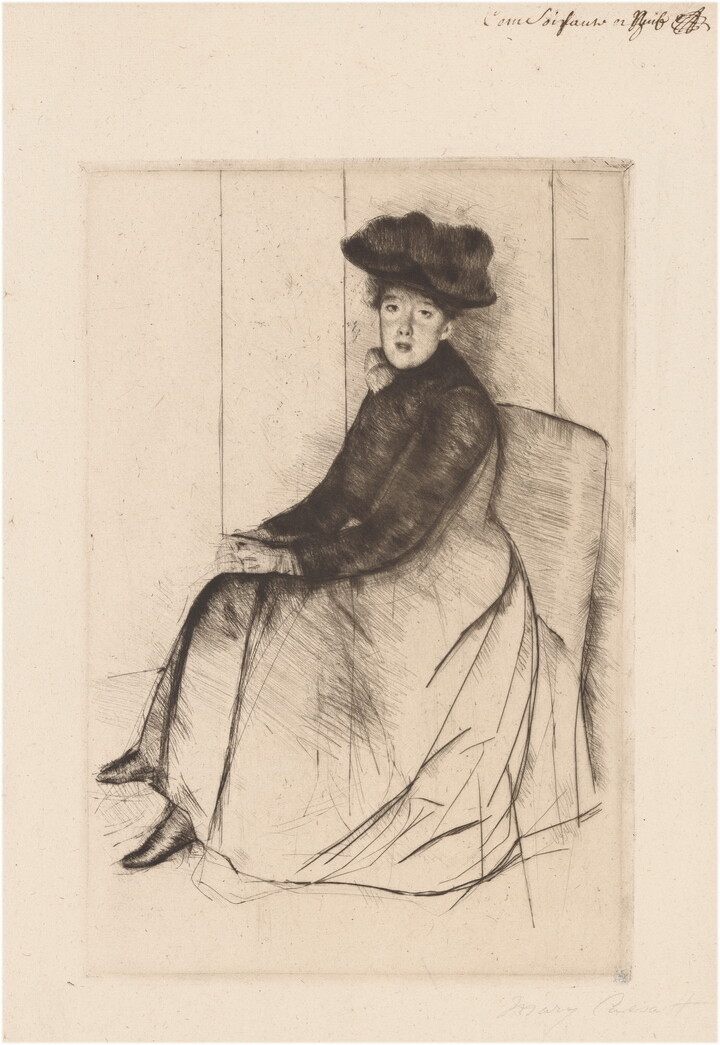
Mary S. Cassatt (1844-1926), Reflection, c. 1890, drypoint on laid paper, Ailsa Mellon Bruce Fund, National Gallery of Art, Washington, D.C., 2024.57.1, Public Domain
Cassatt was 30 when she created this painting and had already lived as an expatriate in Paris for five years; she would remain there until her death at 82. It was only one of two paintings Cassatt painted in distemper, but her challenge was not in a vacuum: In Paris she met fellow artist Edgar Degas, who experimented with the medium alongside her.
The artists encountered each other’s work before encountering each other. According to arts writer Richard Whiddington, Cassatt glimpsed a Degas pastel drawing in a shop window and later claimed, “It changed my life. I saw art then as I wanted to see it.” When Degas observed Cassatt’s oil painting at the Paris Salon, he commented to a fellow artist, “Here is someone who feels as I do.”
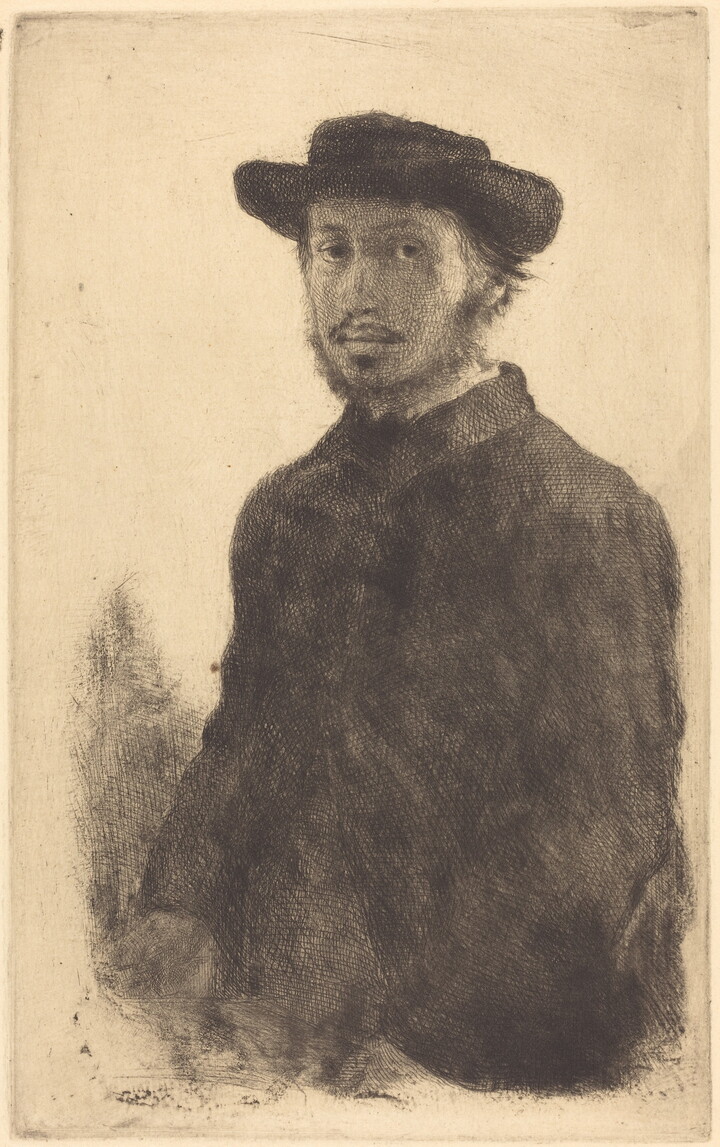
Edgar Degas (1834-1917), Self-Portrait (Edgar Degas, par lui-même), 1857, etching on laid paper, Rosenwald Collection, National Gallery of Art, Washington, D.C., 1943.3.3360, Public Domain
Upon meeting, they discovered parallels in their lives and work. Both were from prosperous banking families and were unmarried without children. Their studios were in proximity. They shared a drive to challenge their artistic boundaries. Yet this was no mentor/mentee relationship, nor is there evidence of a romance. (Cassatt destroyed her letters and diaries before her death.) Rather, they worked head-to-head for a decade, sometimes in competition but often exchanging techniques and critiques.
Degas offered Cassatt an invitation to join and exhibit with the Impressionists, which she gladly accepted, and she probably painted Woman Standing in preparation of the group’s fourth show in 1879. Cassatt benefited Degas in multiple areas, too. She introduced him to the metallic paint she used on the fan in Woman Standing to make its colors more radiant. He incorporated this into his own works. Anything but shy, she negotiated higher prices for his paintings as his sometime agent. She agreed to pose for some of his paintings as well, although the result did not always please her, as in his oil painting Mary Cassatt (1879–1884).
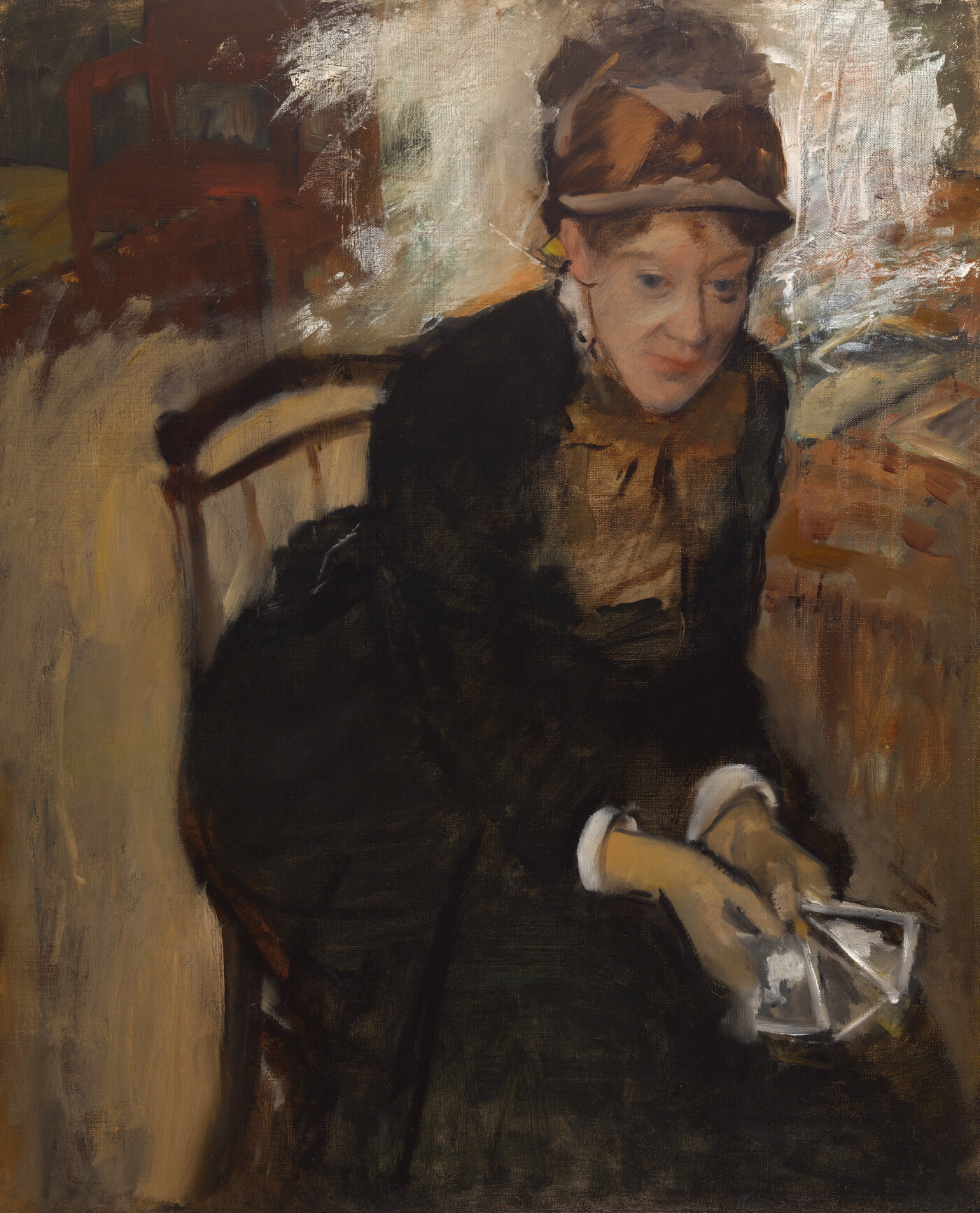
Edgar Degas (1834-1917), Mary Cassatt, c. 1880-84, Oil on canvas, National Portrait Gallery, Smithsonian Institution; gift of the Morris and Gwendolyn Cafritz Foundation and the Regents' Major Acquisitions Fund, Smithsonian Institution, NPG.84.34, CC0
Printmaking was the best example of their teamwork—for a time. In 1879 Degas was immersed in the print medium while Cassatt had barely touched it. However, she learned rapidly once she found that she liked it. They strove together making prints for a proposed journal, Le Jour et la nuit, an ironic title since she worked days in Degas’s studio and nights in her home, sketching the next day’s subject onto copper etching plates.
According to Cassatt’s biographer, Nancy Mathews, this forward momentum stopped suddenly: “After months of work, Degas abruptly declared himself ‘not ready’” for the journal’s deadline. Cassatt was angry; she had heard about his self-interested decision making but had not been its target. Yet when a friend asked her how she survived this behavior, she declared (again according to Mathews), “I am independent! I can live alone and I love to work.”
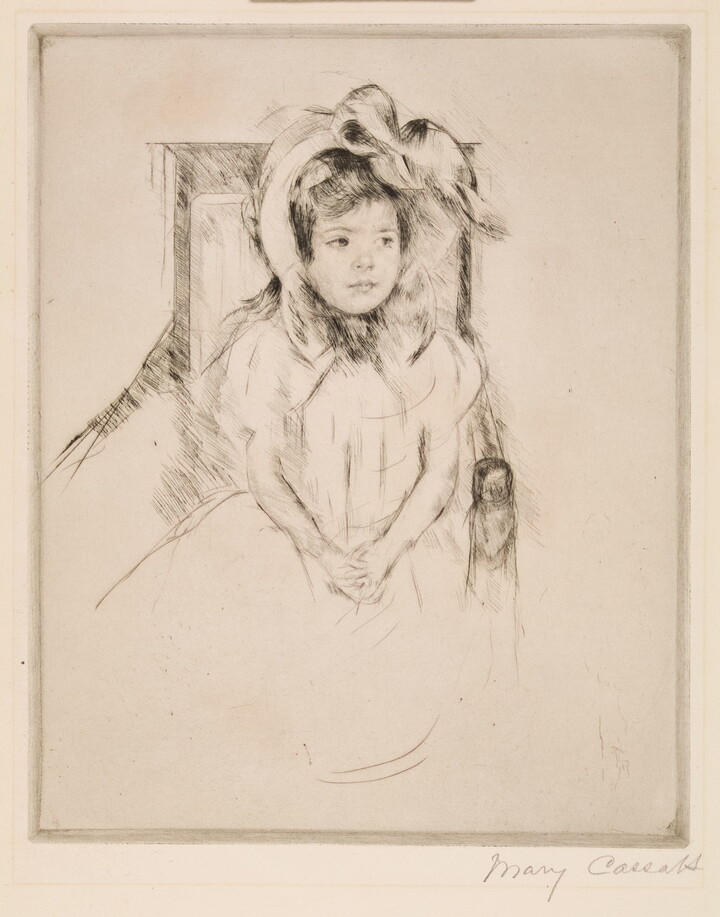
Cassatt made printmaking hers, working independently for the next three decades and creating over 220 prints. The Carter has a healthy handful of them spanning from 1880 to 1904, the heart of her printmaking period, including Interior of a Tramway Passing a Bridge (1891), a well-known aquatint, and a later drypoint print, Margot Wearing a Large Bonnet, Seated in an Armchair (1904).

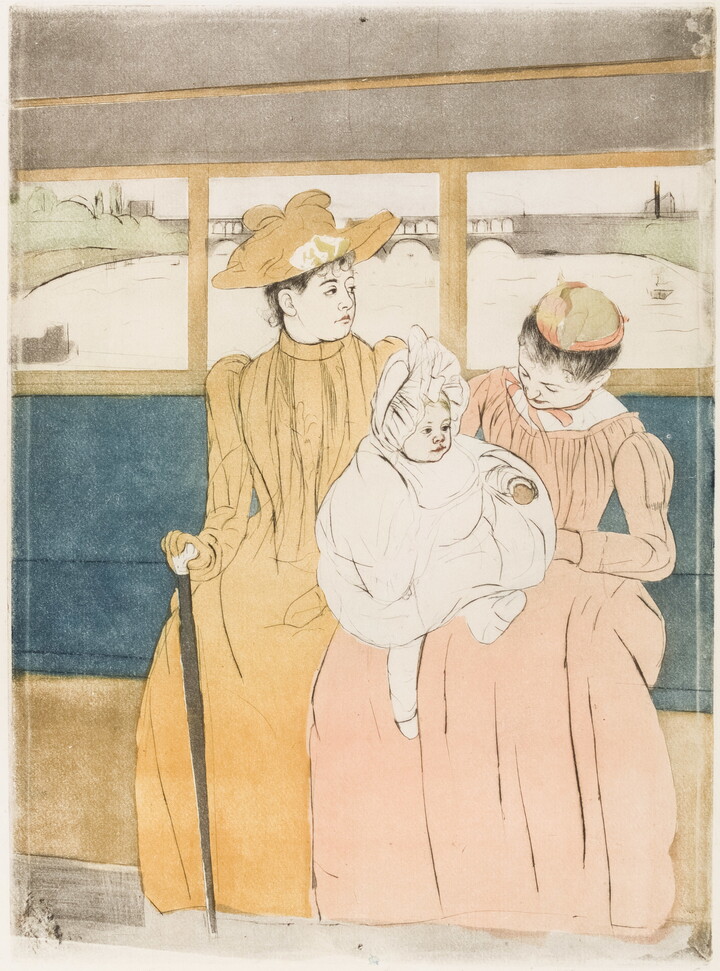
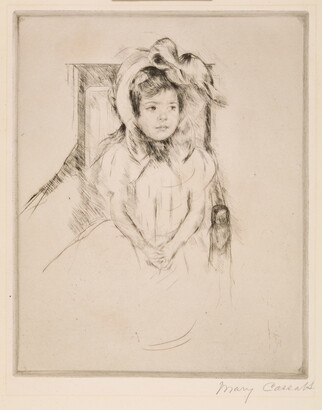
The friendship between Cassatt and Degas did not permanently dissolve. They frequented the same social circles even if they no longer worked together. Sadly, both ceased their art making in their later years due to near blindness: retinal disease in Degas and diabetic retinopathy in Cassatt.
Meanwhile, closer to home, Woman Standing, Holding a Fan remains a rare Cassatt painting due to its distemper medium. It also arrived at the Carter on a rare occasion. In 2011, its acquisition celebrated both the Museum’s 50th birthday and over five decades of Ruth Carter Stevenson’s leadership. There’s more to a woman with a fan than meets the eye.