The Carter Blog
Carter ARTicles
From toilet paper to gravestone rubbings: rethinking adhesives and paper hinges for Here Lyeth
Aug 12, 2026
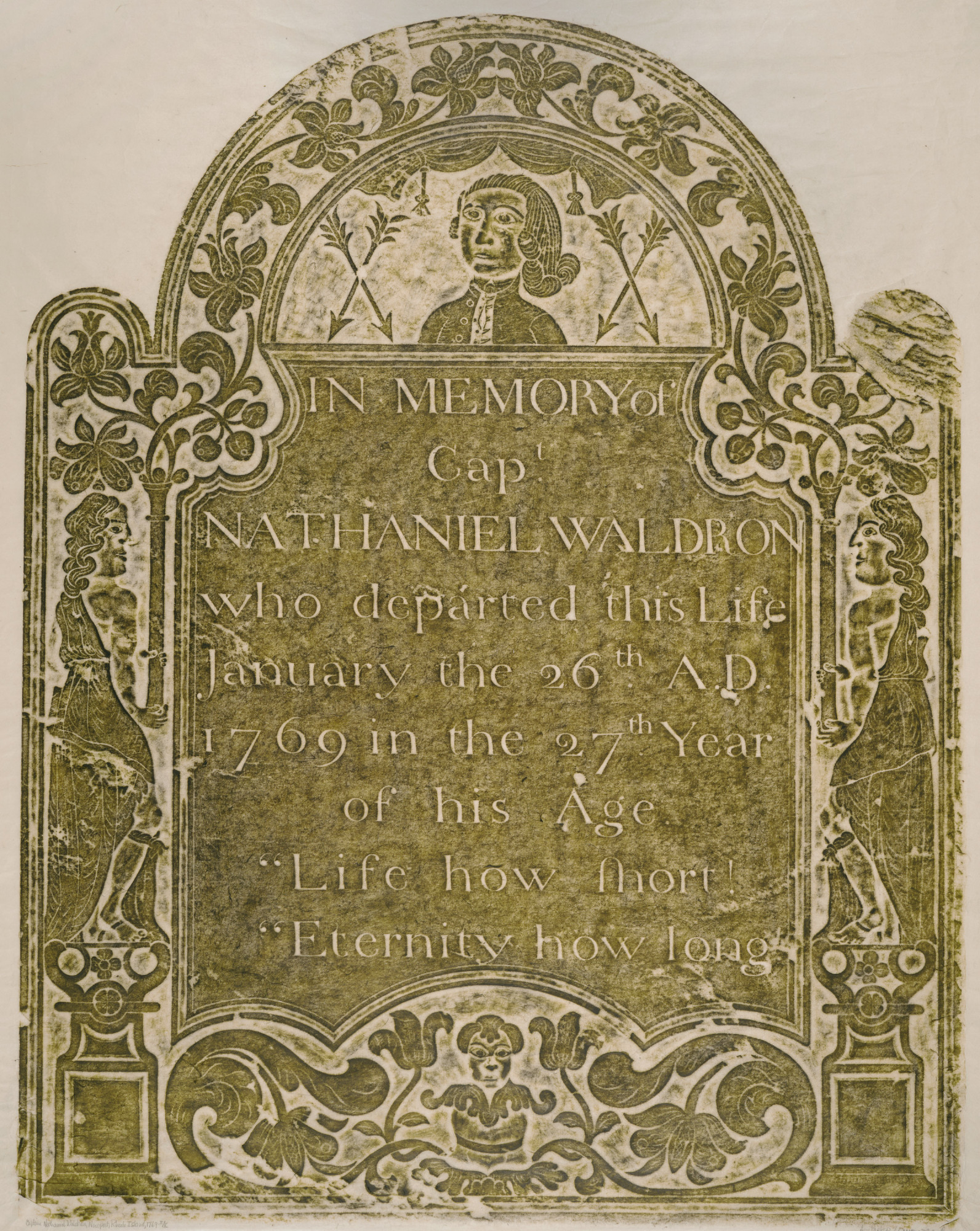
Gravestone rubbings offer a unique way of exploring memory, identity, and craftsmanship through direct impressions of carved stone surfaces. Created by placing Japanese paper sheets over several carved stone surfaces and rubbing a waxy media across them, these artworks capture intricate details that might otherwise go unnoticed just by looking at the original tombstones. The Carter’s collection features 45 rubbings by Ann Parker and Avon Neal, created during travels across New England in the 1960s, supported by the Ford Foundation. Parker and Neal explored Colonial-era burial grounds to record carved motifs that were quickly deteriorating due to age and exposure to the elements. Their work ultimately produced three portfolios of 45 gravestone rubbings, preserving recurring designs, emblems, and symbols that reflect how Americans in the colonial period expressed ideas about life, remembrance, and mortality.
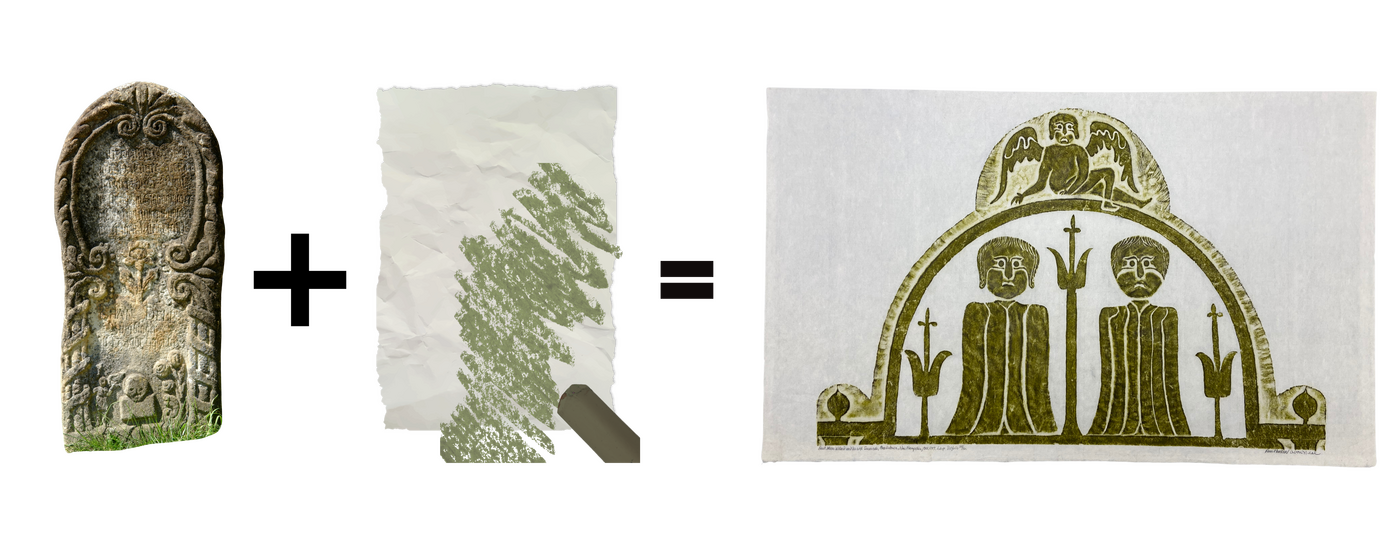
What are gravestone rubbings?
As part of our work in the Conservation Department, we undertook the treatment of a group of 27 rubbings selected for the exhibition Here Lyeth, with plans to address the remaining 18 from the same body of work over the next few months.
Preliminary assessment
During preliminary assessment, our conservation team immediately realized the vulnerability of these objects. The thin and moisture-sensitive Japanese paperjump to citation[x] combined with the textured application of the medium, makes them particularly susceptible to handling and changes in the environment.
As we continued examining the rubbings, it quickly became clear that all of them required some level of conservation treatment, as well as rehousing in more appropriate mounting systemsjump to citation[x] for storage and exhibition. In this case, the mounting system includes both the window mat that supports the artwork and the hinges that secure it in place. The previous mats were unsuitable; they were made from acidic materials and were far too flimsy to properly support these delicate works on paper.
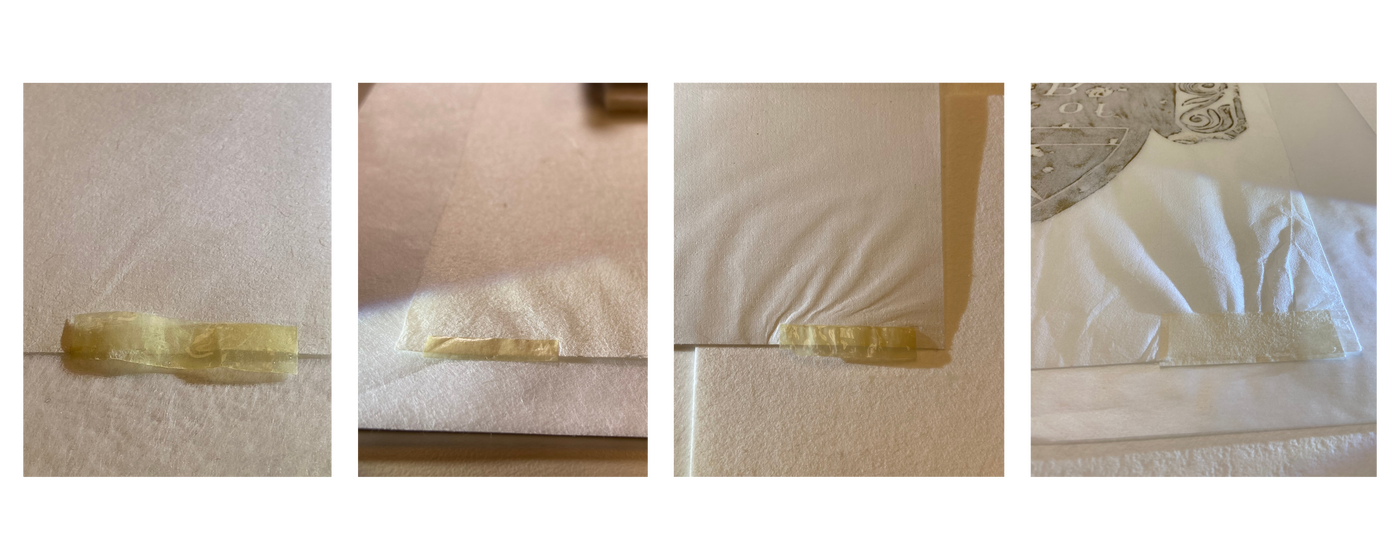
Condition and vulnerability: previous Japanese paper hinges with strong starch and glassine tapes.
We also found that many of the objects had been mounted to window mats using glassine tapejump to citation[x], a type of adhesive tape that is activated with water before application. Given how sensitive the paper supports are to moisture, this has in many cases led to noticeable planar distortionsjump to citation[x], causing the sheets to become wavy and uneven. In addition, glassine tape is known to oxidize over time, and its direct contact with the paper can result in discoloration, staining, and irreversible damage to the objects.
Apart from glassine tape, some of the works were hinged and mounted to the window mats using Japanese paper hingesjump to citation[x]; in these cases, the paper hinges were made of a medium weight Japanese paper adhered with a strong starch adhesive. Although these materials are commonly used in paper conservation, the hinge paper was too thick, and the starch paste probably too concentrated, resulting in localized areas of rigidity, causing further distortions of these delicate tissue paper supports.
Several rubbings also exhibited tears and small losses, particularly along the edges, making stabilization a necessary part of the treatment.
Balanced approach through treatment and re-hinging
The treatment required a balanced approach to address two main challenges: to safely remove the glassine tape and paper hinges while avoiding the introduction of excess moisture that could further distort the paper.
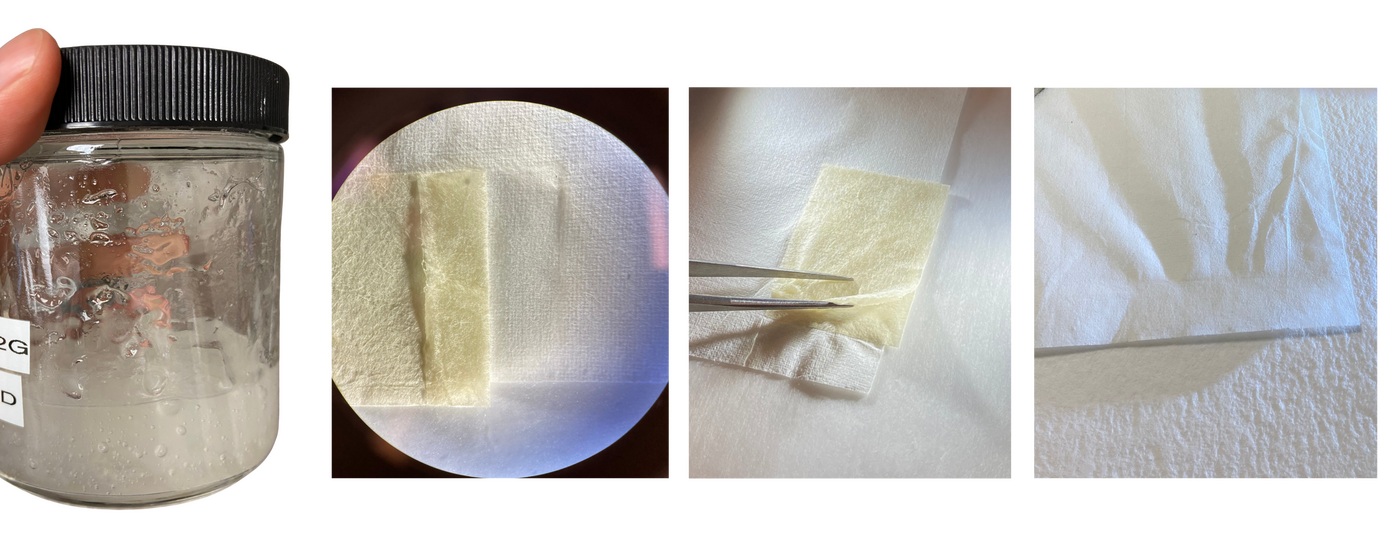
Tape and hinge removal: methyl cellulose gel and documentation of a Japanese paper hinge removal.
To achieve this, we developed a controlled approach to soften and remove these materials without compromising the underlying support. Because both glassine tape and paper hinges are highly sensitive to moisture, their adhesives can be reactivated through controlled humidification. We used a poultice, in this case, a methyl cellulose gel prepared in distilled water to introduce moisture gradually and only where it was needed. By applying the gel directly to the tape and hinges, we were able to soften the paper components and their adhesives, allowing us to gently lift and remove them with tweezers and micro-spatulas while minimizing stress on the fragile paper supports. After tape removal, any adhesive residue was carefully reduced using a slightly dampened cotton swab and a micro-spatula. These areas were then consolidated with methyl cellulose adhesive in distilled water to secure any lifted paper fibers present.
Once all the gravestone rubbings were treated and in stable conditions, we turned our attention to developing a safe hinging method that would ultimately allow us to mount the artworks in acid free housing mats. Given their extreme sensitivity to moisture, selecting an appropriate hinging system was of critical importance.
Before applying any new hinges to the artworks, we carried out a series of tests to determine which materials and methods would provide the best support while introducing the least amount of moisture. Some of our most valuable test subjects were not conservation materials at all, but everyday items: tissue paper and even toilet paper. Because these materials react dramatically to moisture, they provided an excellent way to evaluate how different hinging methods might behave on the delicate gravestone rubbings. Our reasoning was simple: if we could successfully attach hinges to these fragile papers without causing distortion, we could confidently move forward with the actual artworks.
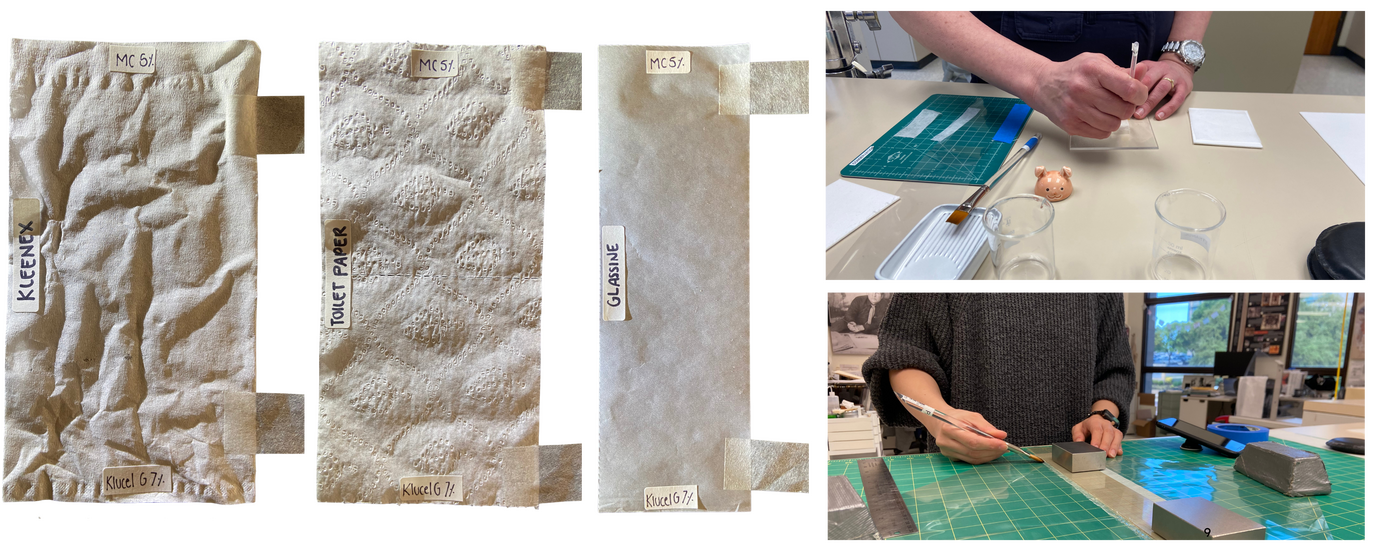
Experimentation of adhesives and application methods on tissue, glassine, and toilet paper.
During our tests, we compared two cellulose-based adhesives commonly used in paper conservation: methyl cellulose prepared in distilled water and hydroxypropyl cellulose (Klucel G) prepared in ethanoljump to citation[x]. We also evaluated two methods for attaching hinges to our mockups, and later to the artworks themselves. The first involved applying the adhesive directly with a brush, while the second used pre-coated hinges that were allowed to dry and later reactivatedjump to citation[x] with their respective solvents before attachment.
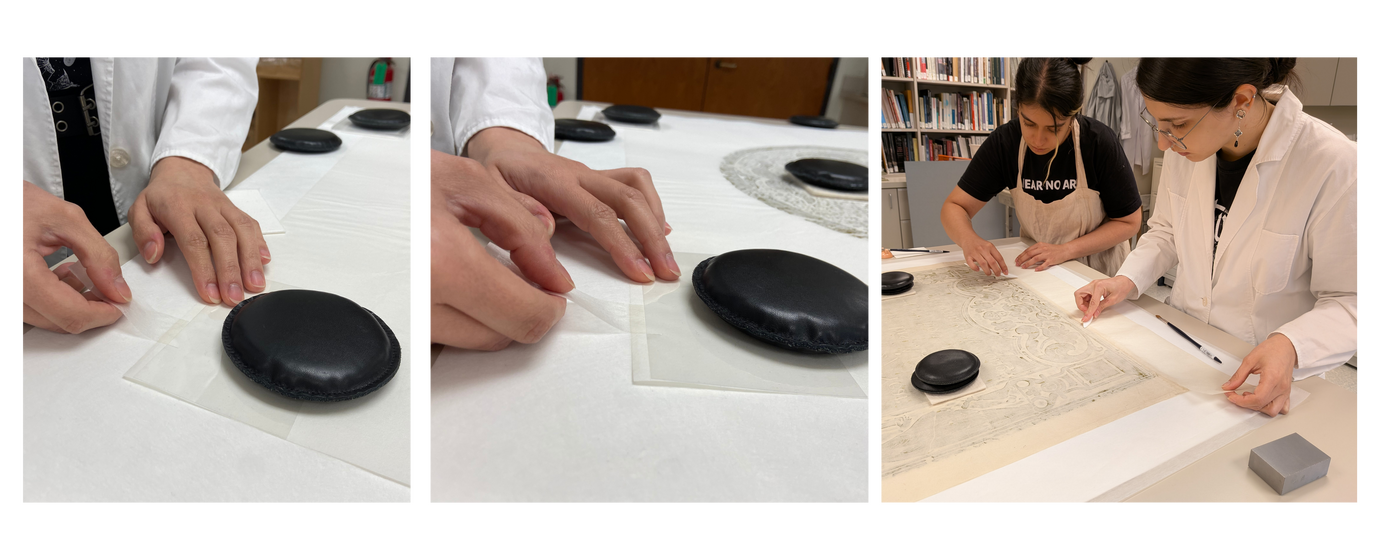
The reactivation method proved particularly effective, producing a stronger and more stable bond between the hinge and the artwork while avoiding planar distortions in the paper support.
After several rounds of testing, it was clear to us that Klucel G pre-coated hinges consistently produced the strongest and most stable results, offering an ideal combination of strength, flexibility, and unnoticeable planar distortions. The success of this method allowed us also to solve another mounting challenge. One of the gravestone rubbings (accession no. 1968.58) bears the artist's signature along its lower edge. Because the artwork was to be displayed in a window mat, part of that lower edge would normally be covered, covering the signature. To avoid this, we created a reversible false marginjump to citation[x] from Japanese paper along the entire bottom edge of the artwork using the same Klucel G pre-coated methodology. The window mat could then overlap the false margin instead of the original artwork, allowing the entire lower edge to remain fully visible while still providing a secure mounting system.
Hinging results and application of a false margin on Captain Nathaniel Waldron, Newport, Rhode Island, 1769.
Citations
- ↵What is Japanese paper? Japanese paper is typically made from plant fibers (kozo, gampi, and mitsumata). Although remarkably strong for its weight and chemically stable, certain types of Japanese paper can be very sensitive to moisture and environmental changes.
- ↵What is a mounting system? A mounting system is more than just a frame. It includes all the materials used to support, protect, and display an artwork, such as window mats, backing boards, and attachment methods like paper hinges or corners. A well-designed mounting system helps prevent damage while allowing the artwork to be safely exhibited and handled.
- ↵What is glassine tape? Glassine tape is made with a smooth, translucent paper carrier and a water-activated adhesive. Although commonly used in the past, it can discolor, become brittle, and damage artworks as it ages.
- ↵What is planar distortion? Planar distortion occurs when paper loses its original flat shape and develops waves, ripples, cockling, or other deformations. It is often caused by uneven exposure to moisture, adhesives, or quick changes in environmental conditions.
- ↵What is a paper hinge? A paper hinge is a small strip of paper used to attach an artwork to a mat or support. Much like the hinge on a door, it allows the artwork to stay securely in place while still moving naturally as temperature and humidity change.
- ↵Why compare methyl cellulose and Klucel G? Both methyl cellulose and Klucel G are cellulose-based adhesives frequently used in paper conservation. Although both come in a powder form, they differ in preparation: methyl cellulose is dispersed in water, whereas Klucel G is dispersed in alcohol. In both cases, dispersion produces a clear gel whose viscosity depends on the concentration of powder. Because the gravestone rubbings were highly sensitive to moisture, reducing the amount of water introduced during treatment became an important factor in selecting the final hinging method.
- ↵What is a reactivated hinge? A reactivated hinge is prepared by applying adhesive to a paper hinge and allowing it to dry before use. When needed, the hinge adhesive can be reactivated with a small amount of solvent, reducing the moisture introduced during attachment and providing greater control during treatment.
- ↵What is a false margin? A false margin is a strip of conservation-quality paper attached to the edge of an artwork to create a safe area for handling or mounting. It allows conservators to support and display an object without covering or altering the original artwork.

Our takeaways and future plans
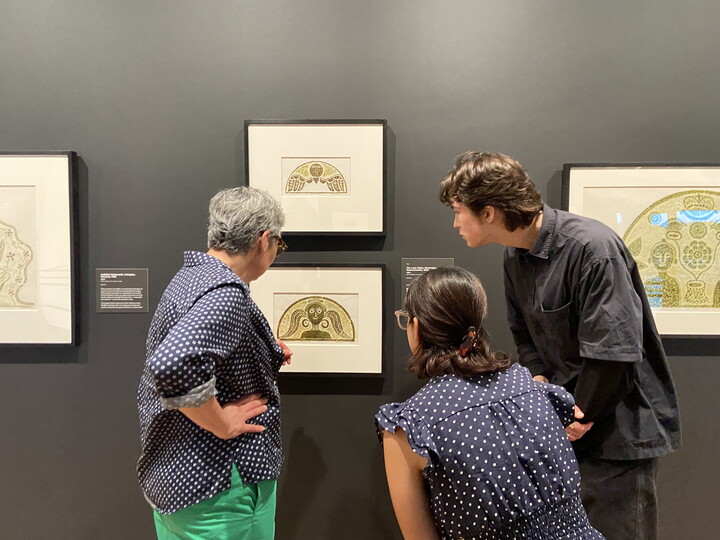
Here Lyeth: Grave Rubbings by Ann Parker and Avon Neal is on view through November 8, 2026.
Working on this project reinforced the importance of adapting conservation and hinging methods to the specific needs of each object. By carefully balancing moisture control and material compatibility with structural stability, we were able to develop a treatment that respects both the physical integrity and the visual aspects of these artworks.
What began with tests on tissue paper and toilet paper ultimately helped us develop a treatment approach capable of supporting these remarkable artworks for exhibition.
As mentioned at the beginning of this blog post, 27 of the treated gravestone rubbings are currently on view in the Carter galleries. We invite visitors to spend time with these remarkable artworks, appreciating not only their interesting textures and details, but also the history and attention to materials they embody. We hope the exhibition offers an opportunity to reflect not only on the artworks themselves, but also on the ongoing care and collaboration between museum professionals that allow such fragile objects to be shared with the public. It has been a true privilege and honor to contribute to the preservation and display of these incredible artworks.