The Carter Blog
Carter ARTicles
A Q&A with our photo conservator
Feb 11, 2026
Carter members receive our biannual Carter Magazine, filled with stories you can only get from the Carter (not a member? Join now!). The current magazine issue features an exclusive Q&A with Craig Kamrath, Associate Conservator of Photographs. We talked with him to get the inside scoop on photo conservation at the Carter. Below is the extended article from the Carter Magazine.
Q: What does an Associate Conservator of Photographs do?
A: My primary responsibility is the long-term care and preservation of the photographic materials in the Museum’s collection. I work closely with the collections and facilities staff to recommend strategies and develop techniques related to long-term storage, to mount artworks for exhibitions, and to prepare artworks to travel as loans.
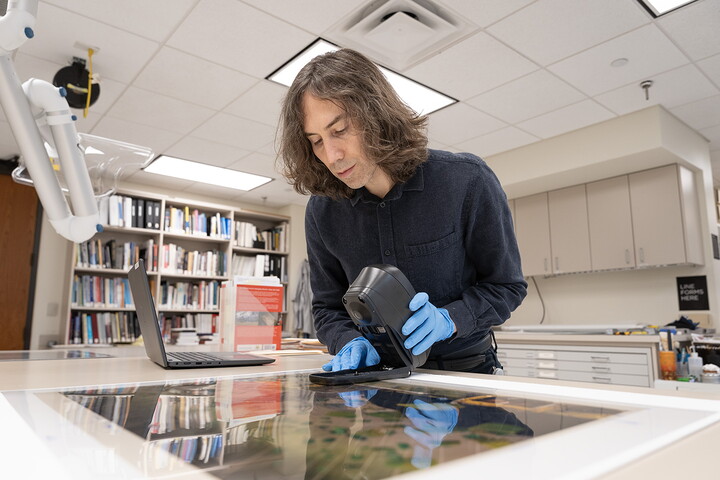
Kamrath uses a spectrophotometer to document color changes in a photograph.
Conservation at the Carter is largely exhibition driven. We examine all artworks prior to their display to determine their stability and perform treatment if necessary. Exposure to light is one of the most impactful sources of degradation for photographic prints. I use a hand-held device called a spectrophotometer to track color changes in photographic prints. A transparent template allows me to take color readings of the same location on a print before and after exhibition and document if and how the exposure to light changed the appearance of the artwork. I also oversee environmental monitoring in all spaces throughout the museum where art is present. Climate data is collected, analyzed, and archived once a month.
Q: What is your favorite part about being a conservator?
A: First, I love being part of the team centered around producing exhibitions. It is fun to collaborate with the other departments and exciting to view a newly installed exhibition. Second, working intimately with the objects in the collection is a unique aspect of the conservation field. Conservators spend a lot of time with art removed from their frames. We get to linger and interact with the art in a way that many cannot. It is special, and I don’t take that for granted.
My favorite treatment project at the Carter was preparing one of Karl Struss’ vintage large format cameras for exhibition Moving Pictures: Karl Struss and the Rise of Hollywood (2024). The bellows of the camera were very noticeably damaged, fragile, and unstable. The camera was vulnerable to sustaining further damage. Stabilizing the camera bellows was complicated and time-consuming. There was a lot of troubleshooting along the way. The result of the treatment was very successful, and I developed some new techniques that will continue to help me in the future.
Q: Why did you want to become a conservator?
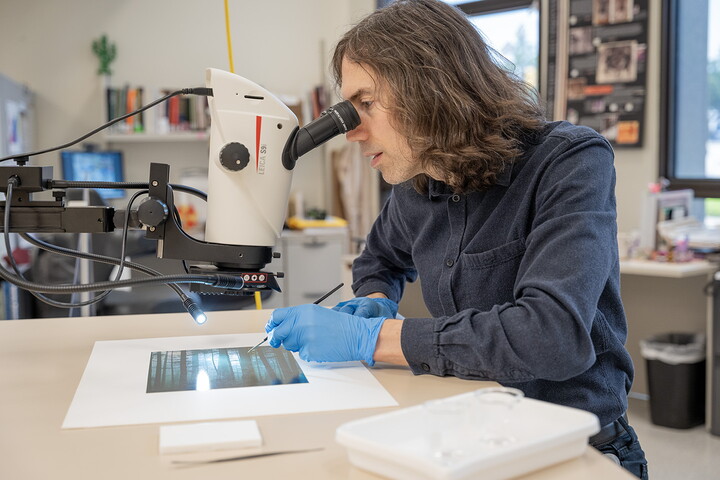
Kamrath examining gelatin binder stability under the microscope.
A: Prior to conservation I worked as a photographer’s assistant at an architectural photography firm. We shot with 4-by-5-inch film and traveled with a lot of lighting equipment, which was fun, but they were beginning to make the switch to digital capture. That, coupled with my waning interest in commercial photography, led me to look for something new. This is when I heard of conservation as a career. I found out that a friend of mine’s dad was a painting conservator. I was intrigued, began learning all I could about conservation, and never looked back. It allowed me to continue working with photography in combination with history and science.
Q: You have lived and worked around the world as a conservator in various museums. Where is the coolest place you have lived and why?
A: This is a very tough choice! Florence, Italy, is my favorite. It was small enough to walk just about anywhere I needed to go but was jammed packed with art, history, and culture. To live in Florence is like living in a museum, everywhere you look there is something beautiful and with a rich historic story.
Q. What are some of the differences you noticed in European conservation vs. American conservation? Are objects handled or treated differently in different countries?
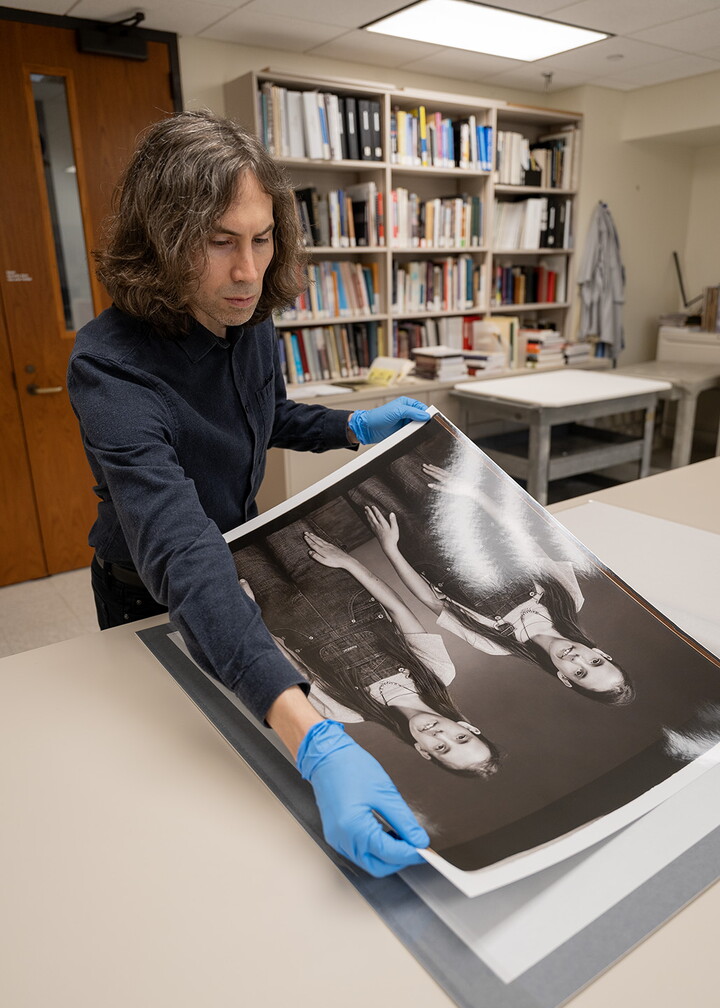
Placing a print inside its storage enclosure.
A: In my experience, the handling is the same, but the materials used have some differences. Oftentimes objects that are materially the same have different names. For example, Mylar in the U.S. vs. Melinex in the U.K., Marvelseal in the U.S. vs. MoistStop in the U.K. Ethafoam is an archival expanded foam commonly used in the U.S. The European equivalent is a different product called Plastazote.
While abroad, I learned about products that are not manufactured in North America, but that I still order to this day. Bondina is a super smooth nonwoven polyester sheet that is used extensively in the conservation of photographs, predominantly as an overlay and in other housing and storage capacities. It has one manufacturer and source in the U.K., and I know of no other comparable material.
Q: What future projects at the Carter are you looking forward to?
A: I’m currently examining a lot of artworks in preparation for Carter exhibitions and loans to other venues. Examinations allow me to identify if artworks need treatment to stabilize them for display, if they need color-monitoring readings taken, or if they have any special needs for installation. Light exposure causes visual changes to photographs. For example, colors can fade or shift tonality, and black-and-white images can develop a yellow tint. The change is cumulative and irreversible.
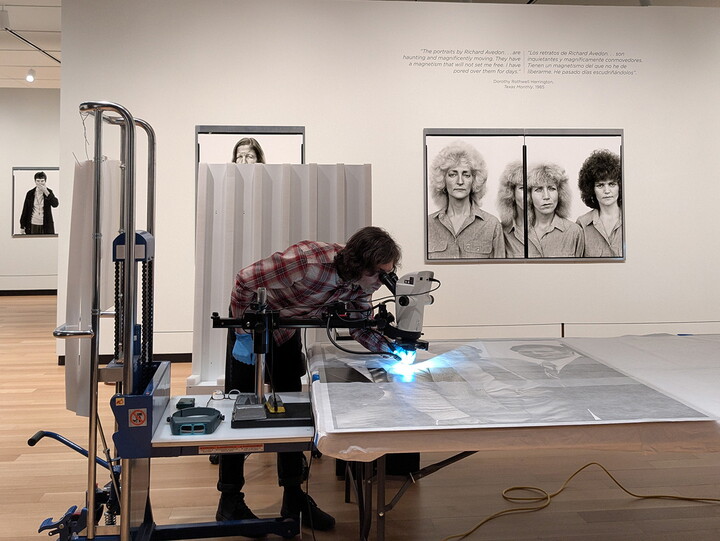
Kamrath treating a Richard Avedon print prior to installation.
Using a spectrophotometer to take color readings before and after each display of an artwork allows us to identify and track any changes. This data informs our decisions of how frequently a photograph can be displayed, how long it can be displayed each time, and the brightness level of the gallery lighting.
Since the Richard Avedon photographs, previously on view in Richard Avedon at the Carter (2025), have no frame and no glazing, we put custom covers on them while they are in storage to provide physical protection. The design has evolved over the years, and we are preparing to test an update to the current design. Full-scale mockups will be created and their functionality will be assessed. If we are satisfied with the results, we will make new covers for all the Avedon photographs.