August 05, 2026 Artist Lava Thomas Monumentalizes Black Presence Through Bold New Installation of Drawings and Artist-Designed Wallpaper at the Carter
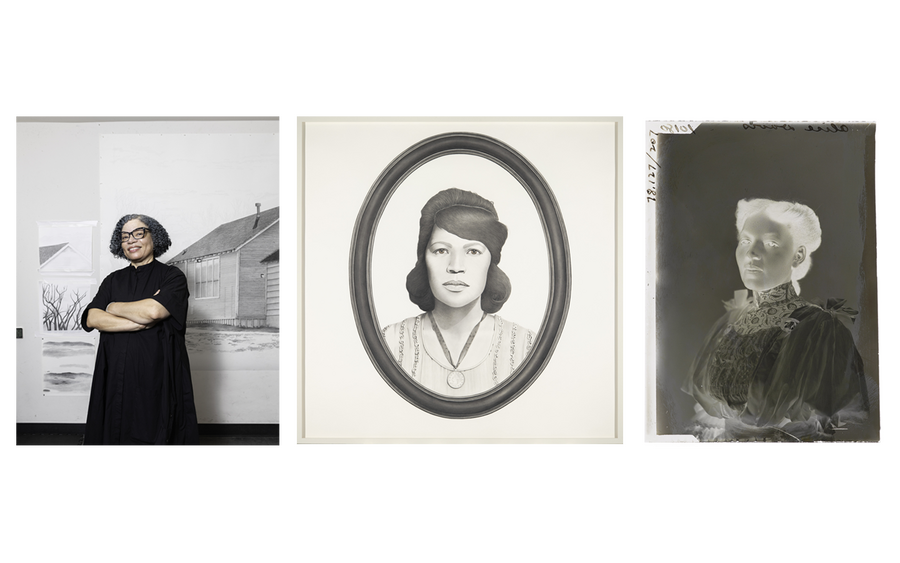
Opening November 2026, Thomas’s dynamic installation examines the role of portraiture in constructing memory, community, and embodied presence throughout time
Fort Worth, TX, August 10, 2026 — The Amon Carter Museum of American Art (the Carter) today announced that it will present large-scale drawings and a newly commissioned, artist-designed wallpaper installation by multidisciplinary artist Lava Thomas. The exhibition will be on view in the Museum’s first-floor sloping gallery—the space linking the Carter’s original 1961 building and its 2001 expansion. Monumentalizing the presence of historical Black figures, this installation marks the first-ever public display of the Carter’s Mary Everhard Collection, from which Thomas selected historical negatives to create wallpaper depicting Black subjects, community, and culture. Lava Thomas: In Our Own Regard will be on view from November 7, 2026, through November 2027.
Based in Berkeley, California, Thomas is celebrated for her meticulous draftsmanship and her use of portraiture as a portal to past American lives that were not historically recorded or prioritized in mainstream portraiture practice. Thomas’s drawing is rooted in her personal archive, from which she transforms largely anonymous and ephemeral images into monumental grand-manner portraiture. Lava Thomas: In Our Own Regard centers on Looking Back II (2015), a 6-by-6 foot graphite, conté pencil, charcoal, and watercolor work on paper acquired by the Carter in February 2026; the work depicts a young Black woman dressed elegantly with a large Liberty coin on a velvet ribbon around her neck. Looking Back II exemplifies the artist’s fastidious, labor-intensive draftsmanship and the detailed precision with which she bestows her unnamed subjects an uncanny lifelikeness and embodied presence. The work will be installed on the artist’s wallpaper alongside seven of Thomas’s other large-scale portraits.
"Lava Thomas's installation exemplifies the Carter's commitment to connecting important historic collections with the work of artists who expand our understanding of American art,” said Scott Wilcox, Interim Director of the Carter. “By bringing the Mary Everhard Collection into public view for the first time through Thomas's powerful artistic vision, this exhibition invites audiences to develop fresh perspectives and deepen their understanding of the people and stories that have shaped American history."
Thomas derived inspiration for her portraits from her grandmother’s album of black-and-white photographs, transforming images of largely unnamed sitters into monumental and majestic subjects. Early 20th-century vernacular photographs, such as those in Thomas’s grandmother’s album, offer vital views of Black American life during the Jim Crow era, when Black Americans were often caricaturized or erased from mainstream visual culture. Through her powerful drawings, Thomas gives the figures a regal gravitas, granting lasting presence and empowerment to subjects previously unseen and unknown.
In addition to building upon the Carter’s strong portraiture tradition, Thomas’s installation engages the Mary Everhard Collection, an important institutional archive that has, until now, remained unexhibited and largely unexamined. The collection of 6,000 negatives, which entered the Carter in 1978, contains a significant number of photographic portraits documenting Black communities in early 20th-century Kansas. Both Thomas’s portraiture practice and the Everhard negatives bring “shadow archives”—those collections long overlooked and hidden from public view—into the light.
While the Mary Everhard Collection illuminates turn-of-the-century life in Kansas, Thomas’s grandmother’s photo album was created in Decatur, Texas, establishing an important connection to Fort Worth’s region and history. Thomas’s portraiture materializes not only individuals, but also the fashion and material culture of North Texas’s middle-class Black communities in the early 20th century. In her drawings, Thomas intervenes in a portrait tradition that has historically excluded Black Americans and reasserts their place in American cultural history.
"Lava Thomas transforms overlooked photographs into profound acts of recognition,” said Michaela Haffner, Assistant Curator of Paintings, Sculpture, and Works on Paper at the Carter. “Her work invites us to encounter individuals whose lives were not often afforded attention within the history of American portraiture. In dialogue with the Mary Everhard Collection, her installation demonstrates how vernacular photography can become a powerful site of memory, presence, and historical recovery, while reclaiming visibility for Black individuals and communities whose stories deserve to be seen.”
With this exhibition, Thomas joins an esteemed list of artists who have presented site-specific installations in the first-floor gallery space as part of the Carter’s commissioning initiative, which has also featured works from Celia Álvarez Muñoz (2026), Jean Shin (2024-25), Leonardo Drew (2023-24), Stephanie Syjuco (2021-22), Natasha Bowdoin (2020-21), and Justin Favela (2019-20). The “Sloping Gallery” initiative, which began in 2019 as a means of reimagining the corridor joining the Carter’s two buildings, provides a venue for the curatorial team to spotlight the work of living artists. While connecting physical spaces, the gallery also bridges past and present, ushering in new work by today’s artists who find inspiration in the Carter’s collection and the American artistic tradition.
Lava Thomas: In Our Own Regard is organized by the Amon Carter Museum of American Art.
About Lava Thomas
Lava Thomas (b. 1958) is a Berkeley-based artist who explores ideas of visibility, embodiment, empowerment, and memorialization through a multidisciplinary practice that spans drawing, painting, sculpture, and site-specific installation. She is best known for her large-scale drawings that monumentalize lesser-known or unknown African American figures and narratives in American history. Engaging with both civic and family archives, Thomas animates and gives presence to historical subjects through the practice of portraiture. Thomas earned a BFA from California College of the Arts in San Francisco, from which she was also later awarded an Honorary Doctorate. She is the recipient of an Academy of Arts and Letters Purchase Prize, a Joan Mitchell Foundation Grant, and an Artadia Award. She has had solo exhibitions at Spelman College Museum of Fine Art in Atlanta, Georgia; Montgomery Museum of Fine Arts in Alabama; Berkeley Art Center in California; and Museum of the African Diaspora in San Francisco. Her work is held in the permanent collections of SFMOMA, Smithsonian American Art Museum, Harvard Art Museums, Studio Museum in Harlem, Berkeley Art Museum, and the Cantor Arts Center at Stanford University, among others. Thomas was named a Yerba Buena Center for the Arts 100 Honoree and was recognized as one of the “Women to Watch” by the National Museum of Women in the Arts. In 2024, the San Francisco Arts Commission unveiled Thomas’s Portrait of a Phenomenal Woman: A Monument to Honor Dr. Angelou for the San Francisco Main Library, the first public monument dedicated to a Black woman in the city’s civic art collection.
About the Amon Carter Museum of American Art
Located in the heart of Fort Worth’s Cultural District, the Amon Carter Museum of American Art (the Carter) is a dynamic cultural resource that provides unique access and insight into the history and future of American creativity through its expansive exhibitions and programming. The Carter’s preeminent collection includes masterworks by legendary American artists such as Ruth Asawa, Alexander Calder, Frederic Church, Stuart Davis, Robert Duncanson, Thomas Eakins, Georgia O’Keeffe, Jacob Lawrence, Frederic Remington, Charles M. Russell, and John Singer Sargent, as well as one of the country’s foremost repositories of American photography. In addition to its innovative exhibition program and engagement with artists working today, the Museum’s premier primary research collection and leading conservation program make it a must-see destination for art lovers and scholars of all ages nationwide. Admission is always free. To learn more about the Carter, visit cartermuseum.org.
Image credit: Lava Thomas headshot, Courtesy of the artist and Jessica Silverman, San Francisco, Photo by Em Monforte; Lava Thomas (b. 1958), Looking Back II, 2015, graphite, charcoal, and Conté pencil on paper, Amon Carter Museum of American Art, Fort Worth, Texas, Purchase with assistance from Doree Friedman, Debra and Ken Hamlett, and Mac McGinnis and Cynthia Cummings, 2026.2, © Lava Thomas; Unknown, Alice Davis, ca. 1895, gelatin dry plate negative, Amon Carter Museum of American Art, Fort Worth, Texas, P1978.127.207